
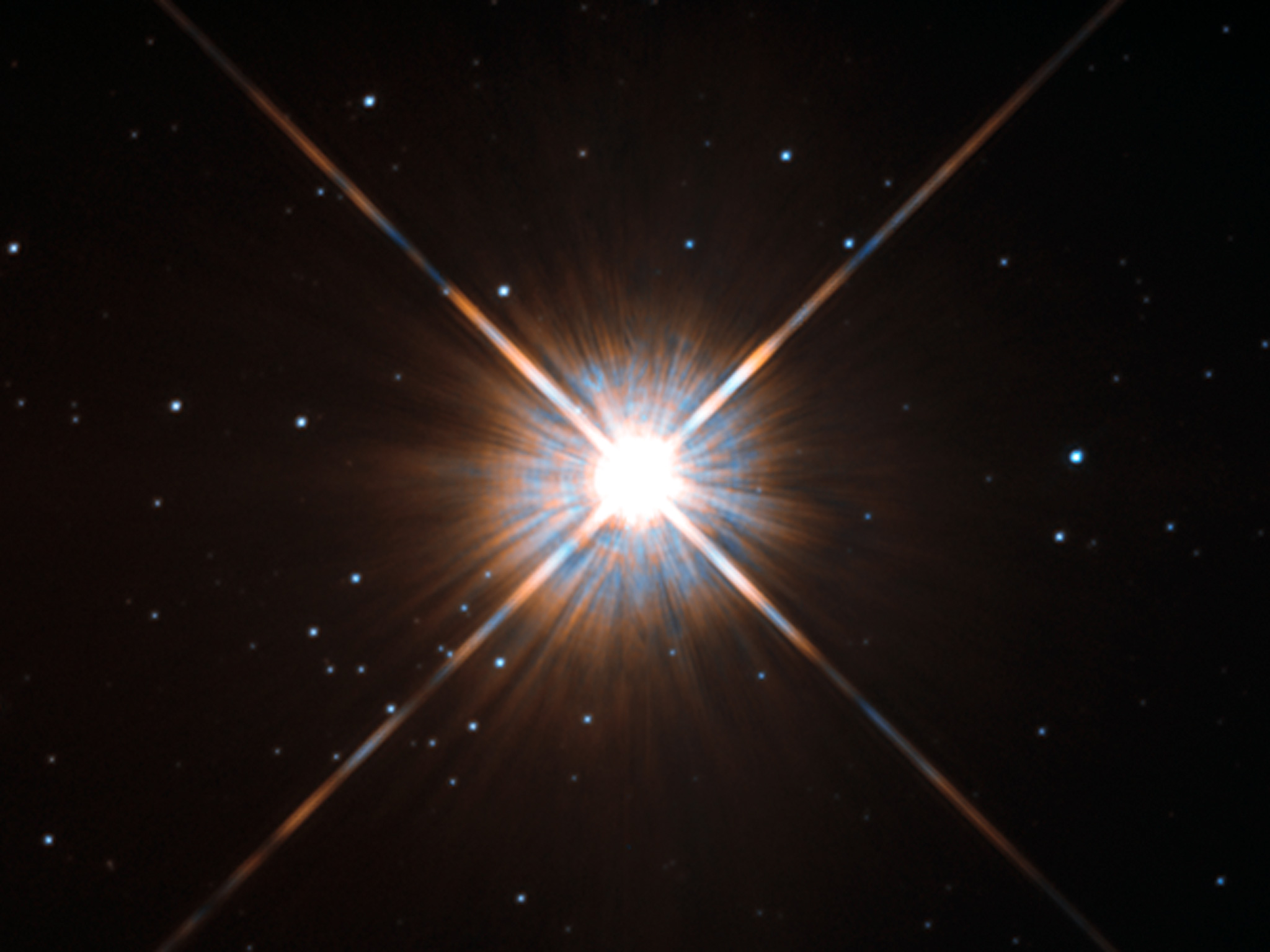
Aside from our Sun, the closest star system is Alpha Centauri. The star system is comprised of a trio of stars located 4.37 light years away from Earth. The three stars are known as Rigil Kentaurus, Toliman, and the smallest Proxima Centauri.
Proxima Centauri is a low mass, main sequence red dwarf. This means the star is smaller in size, dimmer and less in mass compared to our Sun. Due to these factors Proxima Centauri is likely to outlive our Sun by billions of years.
EXOPLANET PROXIMA B
Back in August 2016 Astonomers announced they’d found a planet orbiting Proxima Centauri and said it is likely to be Earth-like due to its orbit being within the orbital zone of the star which is habitable, or at least conducive to the evolution of life as we know it.
The planet named Proxima b, being located within the habitable zone, is approximately 1.3 times the mass of the Earth and is likely host to liquid water – another important component to the conditions required for life to take hold and thrive.
However, if Proxima b is tidally locked to its star then life would be unable to develop due to the extreme differences in temperatures. Being tidally locked means that one side of the planet perpetually faces the star and is thus extremely hot, while the other side remains in darkness and is freezing cold. Our moon is tidally locked to the Earth, which is why we can only see one side of the moon.
POTENTIAL EXOPLANET PROXIMA C
Recently astronomers announced the presence of a potential second planet orbiting Proxima Centauri. The University of Turin’s Mario Damasso highlighted that it is important to note the planet is “only a candidate”, meaning that further study and observation is required to determine whether the planet truly does exist.
If the planet does indeed exist, it is unlikely to be an Earth-like planet due to its size and orbital proximity to its star, which is outside the habitable zone. The planet would be too cold to accommodate life with a temperature equilibrium of minus 234 degrees Celsius.
Scientists including Mario Damasso made use of the High Accuracy Radial velocity Planet Searcher (HARPS) at the La Silla Observatory in Chile to observe the potential planet. HARPS is able to detect the gravitational effects that exoplanets have on their parent stars many light years away.
 Astronomysm