
ASTRONOMICAL HISTORY IS MADE
Space photography has produced an array of awe inspiring photographs, whether they be of the planets in our solar system, stars, or the stellar wonders that are galaxies.
At the centre of most galaxies lie the space-altering, time-warping super-massive black holes that have captured the imaginations of artists and scientists alike. Black holes remain a mystery as very little is understood about them. In fact, human-kind has not been able to produce a real image of the phenomena, until now.
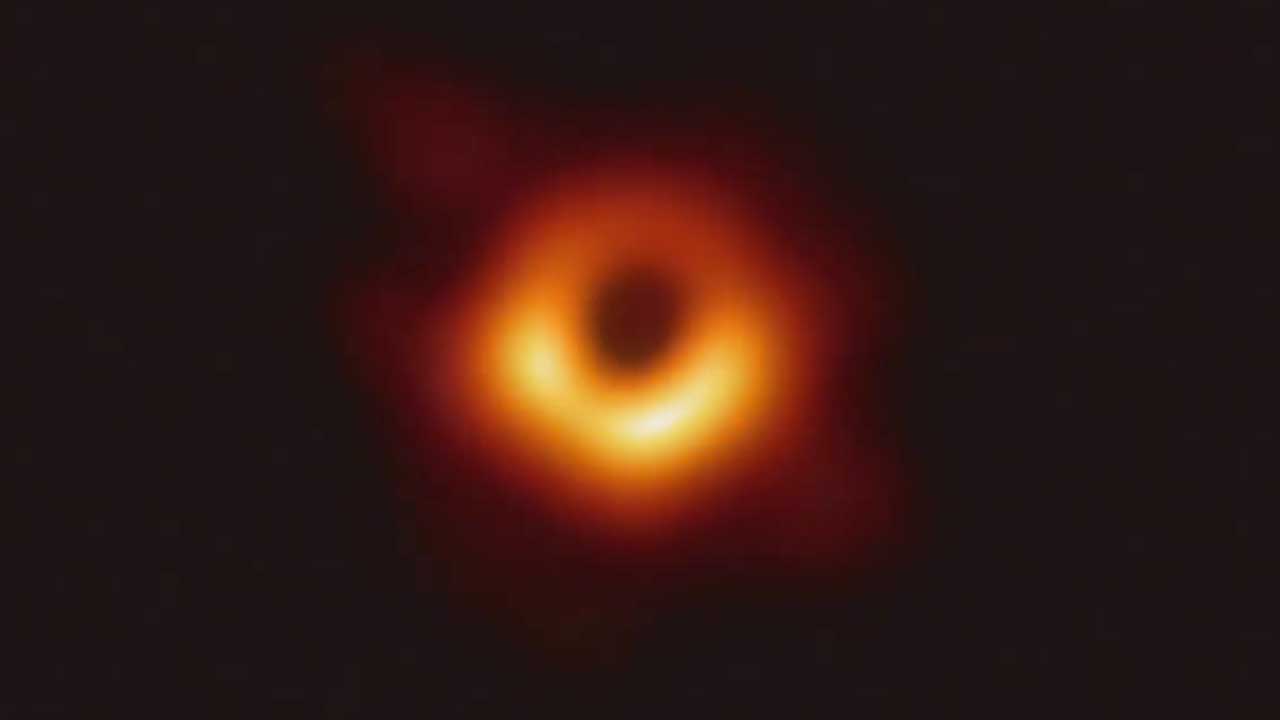
Today, April 10, 2019, scientific history was made when the first real image of the black hole in the centre of the Messier 87 super giant elliptical galaxy, some 55 million light-years away, was photographed by the Event Horizon Telescope (EHT). It has been described as the first visual evidence of a black hole. More than 200 researchers achieved this magnificent feat. The photographed black hole is nicknamed
Pōwehi.
Since light cannot escape a black holes, they are actually invisible. The image is more specifically of the black hole’s event horizon, the light of which produces a shadow of the black hole itself.
Capturing a real image of a black hole was considered impossible decades ago and this image thus serves as a paradigm shift in scientific research of the cosmic phenomenon.
CAPTURING THE IMAGE
As mentioned, the Event Horizon Telescope was responsible for capturing the first real image of a black hole. The EHT wasn’t one telescope, which would have to have been as big as the Earth itself. It is in fact a collaboration – a network of eight different radio telescopes around the globe.
The network of telescopes created a single, virtual telescope. By using a procedure known as very-long-baseline interferometry, the EHT was necessary for producing high-sensitivity and high-angular-resolution.
The data collected by the EHT was then reconstructed by a specialized algorithm created by Katie Bouman, a Massachusetts Institute of Technology (MIT) computer scientist. An astonishing 5 petabytes (5,242,880 gigabytes) was necessary to store the black hole image data. The observation resulting in the historic image was conducted over the course of a week.
The EHT was put together with the goal of observing the environment around Sagittarius A*, the super massive black hole at the centre of our galaxy the Milky Way. Scientists planned to release an image of this black hole in 2017, but have not yet succeeded due to delays encountered at the South Pole Telescope.
Although Sagittarius A* is significantly closer to the Earth being at the centre of our own galaxy, its event horizon is smaller than that of Pōwehi’s thus the time it takes matter to orbit Sagittarius A* is much shorter. This presents challenges to photographing the black hole. Furthermore dust and thick gas clouds lie in the path between Sagittarius A* and the Earth, another challenge to overcome.
FURTHER CONFIRMATION OF GENERAL RELATIVITY
In 1915, world renowned physicist Albert Einstein put forth the geometric theory of gravity, or gravitation known as general relativity. In a (not so scientific) nutshell, general relativity is the theory we use today to understand the mechanics of gravity in both space and time.
Einstein predicted that within the universe there are celestial bodies with a mass so great they would warp spacetime and their gravitational pull would be so intense not even light could escape it – the most extreme instance of general relativity.
Over time more evidence supported the existence of black holes, even though we were unable to see them. The first real image of a black hole serves as further confirmation of Einstein’s theory. He was proven right once more.
 Astronomysm